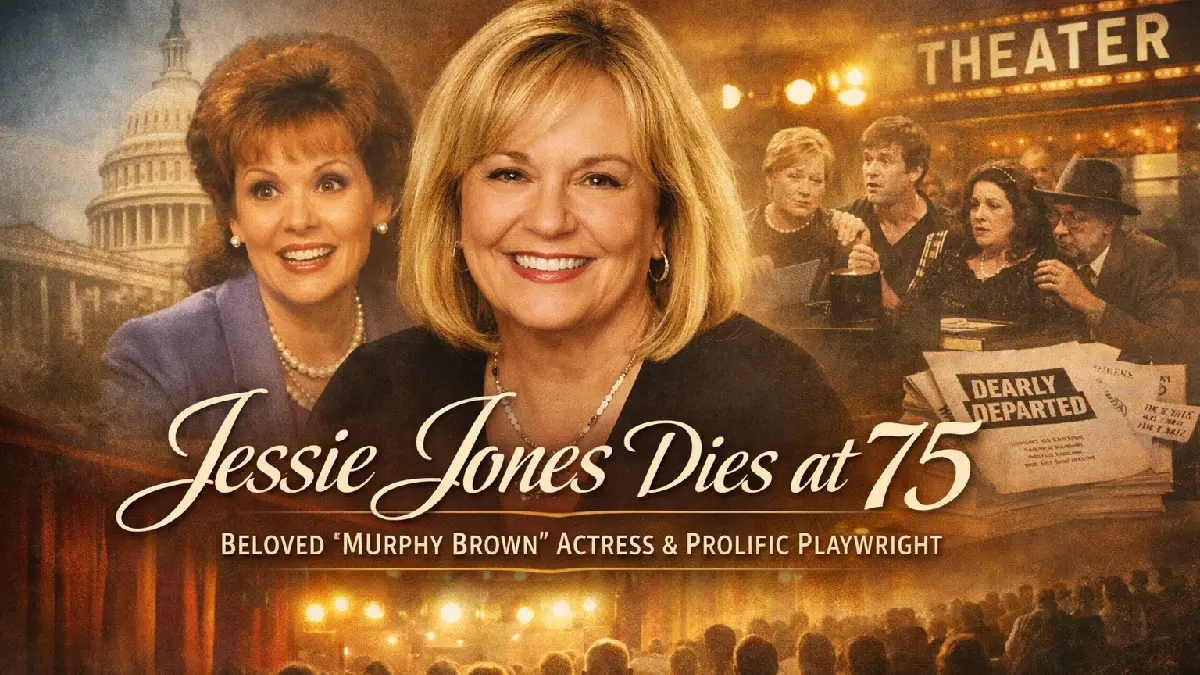

Jessie Jones, the beloved actress known for her role on Murphy Brown and one of America’s most celebrated playwrights, has died at the age of 75.
Her passing on March 20 in Washington, D.C., marks the end of a remarkable career that touched millions through television and theater.
The entertainment world has lost a storyteller who made millions laugh, reflect, and feel seen. Jessie Jones — the unforgettable Murphy Brown actress and the creative force behind some of America’s most-performed plays — has passed away at 75.
Her death isn’t just a loss for television or theater… it’s the end of a voice that defined an entire generation of Southern storytelling.
🔥 Quick Facts
- Born: August 21, 1950, Texas Panhandle
- Died: March 20, 2026, Washington, D.C.
- Location: Washington, D.C.
- Cause: Long illness
- Famous Role: Mrs. Betty Hooley in Murphy Brown
- Career Shift: From TV actress to record-breaking playwright
- Legacy: Co-wrote 25+ plays performed worldwide
A Familiar Face on TV — But Never Ordinary
Before she became a theatrical legend, Jessie Jones was a face audiences instantly recognized.
From Murphy Brown to Melrose Place, Night Court, and Designing Women, she appeared in some of the most iconic shows of the late 20th century.
Her performances were often brief — but unforgettable.
In Murphy Brown, her portrayal of Mrs. Betty Hooley shocked viewers with its unexpected depth and biting social commentary. It was comedy… but it made people uncomfortable in the best way.
She didn’t just act — she left an impression.
When She Walked Away From Fame — And Changed Theater Forever
At the height of her acting career, Jessie Jones made a bold choice.
She stepped away from the spotlight.
Not because she had to — but because she had something bigger to say.
That decision led to one of the most remarkable second acts in entertainment history.
Teaming up with Jamie Wooten and Nicholas Hope, she co-created a powerhouse of Southern storytelling that would dominate regional theater for decades.
Why Jessie Jones Was So Loved
- One of the most-produced female playwrights in the U.S.
- Known for relatable, heartfelt storytelling
- Gained mainstream recognition through Murphy Brown
- Inspired generations of women writers
The Plays That Reached Every Corner of America
Jessie Jones didn’t just write plays — she created cultural touchstones.
| Play Title | Why It Mattered |
|---|---|
| Dearly Departed | A funeral comedy that became a global hit |
| The Sweet Delilah Swim Club | Deeply emotional story of lifelong friendship |
| The Red Velvet Cake War | A chaotic, hilarious Southern family saga |
| Christmas Belles | Holiday humor with heart |
| The Savannah Sipping Society | Women, resilience, and second chances |
Her breakout hit “Dearly Departed” even made it to film, proving her stories could travel far beyond the stage.
What made her writing special?
It was real.
Messy families. Strong women. Laughter hiding pain.
Audiences didn’t just watch her plays — they saw themselves in them.
“She Lit Up Every Room” — The Woman Behind the Words
Those who knew Jessie Jones didn’t just admire her talent — they loved her presence.
One tribute described her as:
“Witty, stylish, and exceedingly kind… the very definition of vivacious.”
Her longtime collaborator Jamie Wooten confirmed her passing, remembering not just a creative partner — but a lifelong friend.
She wasn’t just a writer or actress.
She was the kind of person who made people feel seen, heard, and welcomed.
From Texas Roots to Global Legacy
Born in the Texas Panhandle, Jessie Jones carried her roots into everything she created.
That authenticity became her superpower.
Her plays went on to be performed in all 50 U.S. states and across more than 25 countries — making her one of the most-produced female playwrights in American history.
That’s not just success.
That’s influence.
Did Jessie Jones Change American Theater?
Absolutely.
Before Jones, Southern comedies were often reduced to stereotypes.
She changed that — completely.
Her characters were:
- Funny, but flawed
- Strong, but vulnerable
- Southern, but universal
Today, her scripts are still used by community theaters, directors, and actors learning the craft.
Her work didn’t just entertain.
It trained a generation.
Why “Jessie Jones Murphy Brown” Still Trends Today
Even years after her most memorable appearances, search interest around Jessie Jones Murphy Brown continues to rise — and for good reason.
Many fans still remember Jessie Jones from Murphy Brown for her bold and unforgettable role as Mrs. Betty Hooley, a character that sparked both laughter and uncomfortable truths in a single scene.
In fact, people frequently search variations like Jesse Jones actress Murphy Brown, Jesse Jones on Murphy Brown, or even Murphy Brown Jessie Jones, trying to revisit that iconic performance that made her stand out despite limited screen time.
Her presence wasn’t limited to just one show either. Viewers who discovered her through sitcom reruns often look up Jessie Jones Night Court, where she also delivered strong supporting performances during the golden era of television comedy.
At the same time, recent searches like Jessie Jones cause of death reflect the emotional impact of her passing. Fans across generations are not just revisiting her work — they’re trying to understand the life behind the performances.
Jessie Jones may not have always been the lead, but she had something far more rare:
she was unforgettable, even in a single scene.
The Role That Still Defines Her Legacy
Even today, many fans searching Murphy Brown Jessie Jones or Jessie Jones on Murphy Brown are trying to revisit the moment that made her unforgettable.
As a Jessie Jones Murphy Brown actress, she didn’t need long screen time to leave a lasting impression. Her role was brief — but powerful enough that viewers still search for Jessie Jones in Murphy Brown decades later.
For many, she remains the Murphy Brown star Jessie Jones who delivered a performance that blended humor with sharp social commentary. It’s why phrases like actress Jessie Jones and even Jesse Jones actress continue trending whenever her name resurfaces in the news.
But her television journey went far beyond a single show. Fans often rediscover her through searches like Jessie Jones Designing Women and Jessie Jones Melrose Place, remembering how she quietly became a familiar face across some of TV’s most iconic series of the 80s and 90s.
In recent days, interest has surged again with searches like Jessie Jones died and Jessie Jones dies, as audiences try to understand the loss of a performer who meant so much to both television and theater. Reports confirm that the Jessie Jones actress and playwright passed away at 75 after a long illness, leaving behind a legacy that continues to resonate.
She may not have always been the lead — but Jessie Jones had something rare:
she was unforgettable, every single time she appeared on screen.
A Final Goodbye That Feels Personal
Jessie Jones passed away on March 20, 2026, after a long illness, surrounded by the legacy she built.
She is survived by her family — and something even larger:
A body of work that continues to live, breathe, and perform on stages around the world.
Frequently Asked Questions (FAQ)
Who was Jessie Jones?
Jessie Jones was an American actress and playwright best known for her work on Murphy Brown and her widely performed stage productions.
How did Jessie Jones die?
She passed away after a long illness on March 20, 2026.
What are her most famous plays?
Her most notable works include Dearly Departed, The Sweet Delilah Swim Club, and The Savannah Sipping Society.
Why is she important to theater?
She became one of the most-produced female playwrights, shaping regional and community theater across the U.S.
What is her legacy?
She remains one of the most influential female playwrights in American theater.
A Legacy That Refuses to Fade
Some artists chase fame.
Jessie Jones chased connection.
And in doing so, she created stories that will outlive trends, headlines, and even generations.
Her voice may be gone…
But her characters will keep speaking — laughing, arguing, loving — on stages everywhere.
And maybe that’s the most powerful ending of all.
About the Author